About the Cumbrian Lakes
Few areas of the world have as rich a limnological heritage as the English Lake District. The lakes of Cumbria were formed by glaciation more than 15,000 years ago. They comprise more than 300 lakes and tarns and their high diversity in size and chemistry makes them an extremely valuable scientific asset. They are located in a region of natural beauty which attracts around 15 million visitors every year and is important for the local economy.
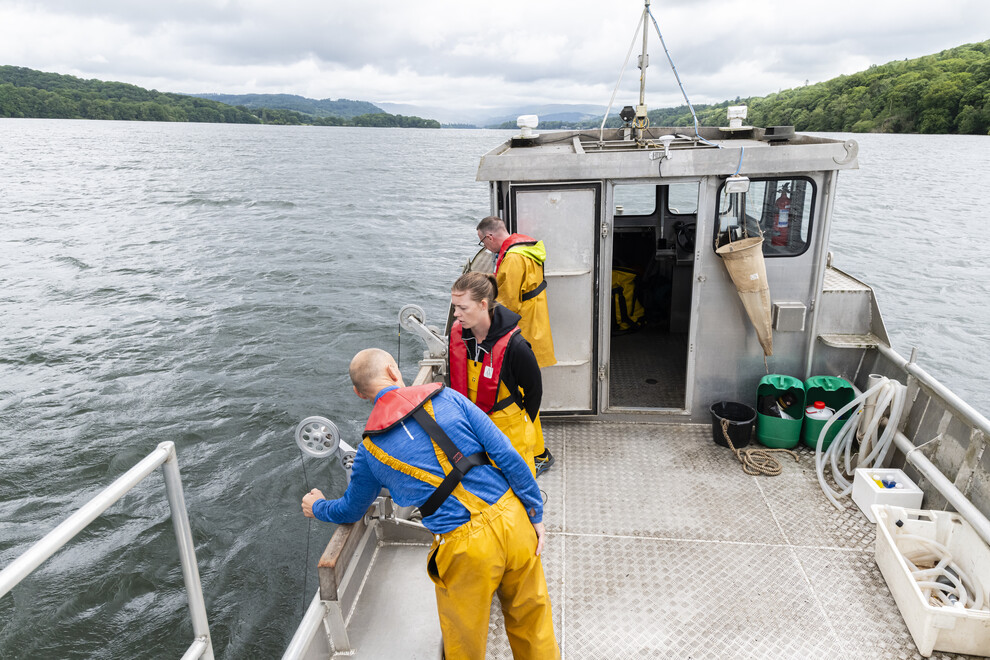
We conduct regular monitoring on the two basins of Windermere, England's largest natural lake (15km2 with a maximum depth of 64m), Esthwaite Water (1.0km2), and Blelham Tarn (0.1km2). Research on some of these lakes was initiated by the Freshwater Biological Association but UKCEH has maintained this work for more than 25 years. At various times the monitoring programme has involved collecting:
- Fortnightly data for a suite of physical, chemical and biological variables including temperature and oxygen profiles, Secchi depth, nutrients, pH, alkalinity, phytoplankton chlorophyll a and species composition, and zooplankton density.
- Data on fish community composition and relative abundance at four basins.
- Population data for Arctic charr, perch and pike for both basins of Windermere.
- Hydroacoustic fish data (day and night) on Windermere and seasonal night fish data on Bassenthwaite Lake and Derwent Water.
- High-frequency meteorological and limnological data from automatic water quality monitoring stations at four sites.
In addition, quinquennial, seasonal surveys of 20 Cumbrian lakes, the "Lakes Tour", have been undertaken in conjunction with stakeholders.